Dame Louise McIlroy, a Ballycastle Presbyterian and Pioneer for Women working in the Medical Profession, 1874-1968
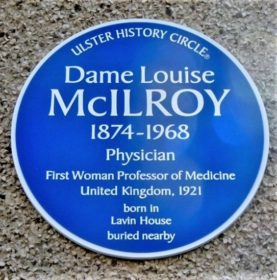
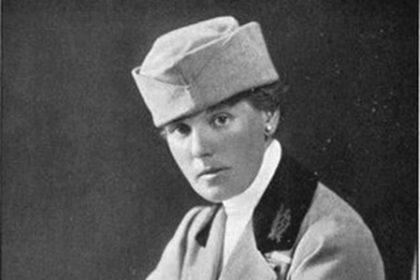 Here is yet another Presbyterian lady who made her mark in society and who has been honoured with an Ulster History Circle Blue Plaque at Ballycastle Presbyterian Church.
Annie Louise McIlroy, known as Louise, was born on 11 November 1874 at Lavin House in the townland of Knockahollet, the daughter of Dr James McIlroy, a medical practitioner, (born 1844 and died in 28 July 1912 in Ballycastle aged 68) and Annie Hamilton (born 1842 and died 1922) who married 20 March 1872 in 1st Ballymoney Presbyterian Church. She worshipped with her family in Kilraughts Presbyterian Church. Louise was the eldest of 4 daughters of James and Annie – her other sisters were Jane Hamilton (born c.1878), Edith Mary (born 29 March 1880 at Lavin), and Matilda Gilmore (born 1 May 1882 at Lavin). Louise also had 2 brothers – Richard Hamilton (born 17 Apr 1873 at Lavin) and James Stevenson (born 13 July 1877 at Lavin). The family relocated to Ballycastle when her father, James, became medical officer to the district that included both the Workhouse and the Fever Hospital as well as Rathlin Island.
Dame Louise was educated in Ballymena and Ballycastle (she attended intermediate school in Ballycastle Presbyterian Church Hall) and, sharing her father’s love of medicine, went on to study medicine at Glasgow University where she quickly became a star pupil - not only winning prizes in medicine and pathology but also became the first woman to graduate in medicine from that University in 1898. This was the start of her pioneering work for women working in the medical profession. As Sir Peter Froggatt states in his ‘Directory of Ulster Doctors’ – ‘So began the career of one of the most respected woman medical professors’.
Following her award of an MD with commendation in 1901 (the first woman to earn a doctorate in medicine) she registered as a research student at Glasgow University, specialising in gynaecology and obstetrics that took her throughout Europe. Her first appointment was as a house surgeon at the Samaritan Hospital for Women in Glasgow in 1900, followed by Gynaecological Surgeon at the Victoria Infirmary in Glasgow from 1906 to 1910. She returned to her studies at Glasgow University gaining a DSc in 1910 and then took up the position of First Assistant to Professor J M Munro Kerr, Chair of Obstetrics and Gynaecology at Glasgow.
Her career was then interrupted by the First World War in which she showed initiative and courage. She, along with other women medical graduates, offered her services to the government but was turned down though was accepted by the French government. Defying officials in London she took charge of a mobile hospital in France at the start of the First World War when, despite being told that "battlefields are no place for a woman", she joined the Scottish Women’s Hospitals Foreign Service. As Chief Medical Officer with the French Expeditionary Force she set up tented hospitals caring for hundreds of patients in Serbia and later in the Greek port of Salonika. She had to cope with overcrowding, extreme weather, remoteness and disease, conditions that would have been challenging even for her male colleagues.
The field hospitals she ran became known for their surgical brilliance and efficient administration according to Sir Peter Froggatt’s "Directory of Ulster Doctors". She finished her wartime service by becoming a surgeon in the Royal Army Medical Corps in Constantinople. In recognition of her service during the war she was awarded the Croix de Guerre by the French government and four years later in 1920 an OBE by King George V.
In 1921 she was appointed to the Royal Free Hospital in London as consultant in obstetrics and gynaecology and became Professor of Obstetrics and Gynaecology at the London School of Medicine for Women, the first woman to hold such an appointment in the United Kingdom. Even the press not only highlighted the significance of the appointment but also the amount of her salary - "£2,000 is the largest ever paid to a woman for university work". She would spend the next 15 years in London during which time she was made a Dame in 1929 in recognition of her significant contributions to the field of obstetrics and gynaecology including advancements in pain relief during childbirth. In the same year she became one of the founding Fellows of the Royal College of Obstetricians and Gynaecologists. Two years later she became an Honorary Doctor of Science awarded by Queen’s University, Belfast, of which she was justly proud.
She took early retirement in 1934 hoping to have "a few years of freedom" but the Second World War intervened and she immediately offered her services again. Throughout the war she organised emergency maternity services in Buckinghamshire, working tirelessly, often through the black-outs with minimal equipment and support.
Returning to Scotland to live with her sister in Ayrshire she died at Turnberry in February 1968 aged 94. It was her dying wish to be buried in the family grave at Ballycastle Presbyterian Church alongside her father and mother who were buried beside the front door of the church. The minister at the time was the Very Rev Dr Godfrey Brown who conducted the service of interment for Dame Louise and her sister Jane whose ashes were brought over from Scotland. It was very fitting that Dr Brown was present at the unveiling of an Ulster History Circle blue plaque commemorating the life of Dame Louise.
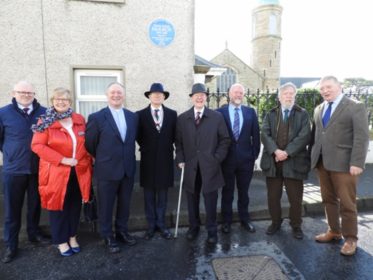 Unveiling of the Blue Plaque to Dame Louise at Ballycastle Presbyterian Church, 28 March 2025
- Ian Williamson, Principal-Ballycastle High School, Lavinia Tilson-Board Director, Ulster- Scots Agency (Blue Plaque Sponsor), Rev. Garry Glasgow, Col. Neill Salisbury, D.L., Very Rev. Dr. Godfrey Brown, Paul Hayes, property convenor-Ballycastle Presbyterian Church, Chris Spurr, Chairman-Ulster History Circle and Derek Reaney, Ulster-Scots Agency
"Hers was a long life, spanning world wars and innumerable lesser, but no less challenging, conflicts in her professional life, as she fought for not just personal recognition but for that of all women in medicine. She will be remembered as the first woman to reach many medical milestones, but perhaps her real legacy is as a clinician who fought for the well-being of the women in her care." (MDDUS website)